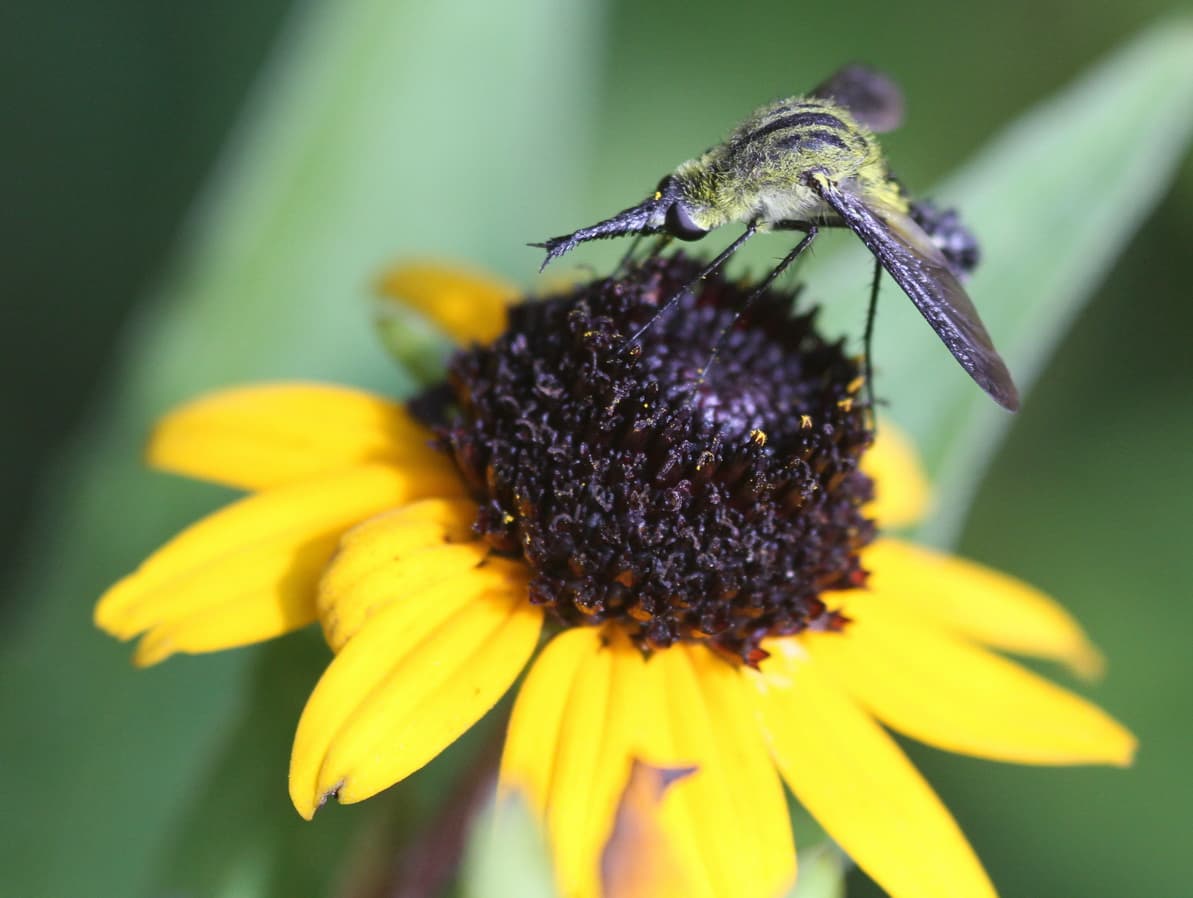
Lepidophora lutea / Lepidophora lepidocera
Hunchback Bee Fly
Everyone notices the bee mimic. But look closer and the illusion is more intricate than it first appears.
The hunchback bee fly is not a bee at all. Its fuzzy thorax and hovering flight are classic Batesian mimicry — a harmless species imitating a stinging one. Predators hesitate, and that hesitation is often enough. Its long, rigid proboscis extends forward like a needle, allowing it to feed on nectar without ever landing, keeping its delicate body out of reach.
The wings beat rapidly, holding it in a near-perfect hover. Unlike true bees, it never settles into the flower. It hangs in place, adjusts with subtle precision, and darts away in an instant. The posture — slightly arched, almost hunched — gives the insect its name and distinguishes it from its models.
What looks gentle is, in part, deceptive. As larvae, many bee flies are parasitoids, laying eggs near the nests of solitary bees or wasps. The emerging young consume the host provisions — sometimes even the host itself. Beauty and brutality, bound into one lifecycle.
This particular moment was captured in warm afternoon light, the insect suspended mid-air above a wildflower. The blurred wings vanished into transparency, while the body remained sharply defined — a fleeting balance between motion and stillness.
Photography by
Tim Smith ↗